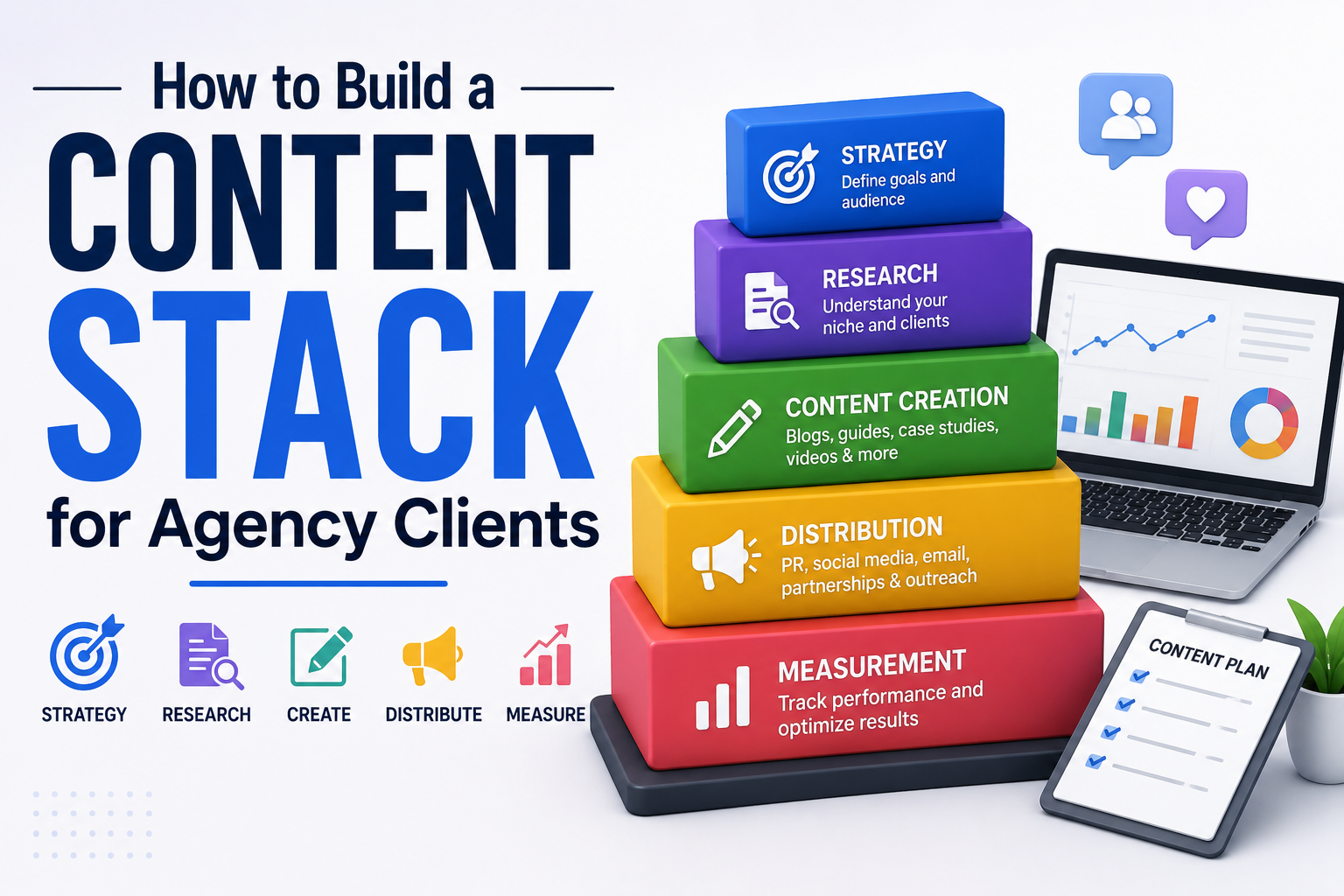
Every successful marketing campaign relies on more than a single blog post or social media update. Today’s businesses need a consistent flow of high quality content that supports brand awareness, search visibility, lead generation, and customer engagement. This is where a well planned content stack becomes essential.
For agencies, offering a content stack instead of individual content pieces creates greater value for clients while improving efficiency and recurring revenue. Rather than producing isolated assets, agencies develop a connected ecosystem where every piece of content supports the others.
This guide explains how to build an effective content stack for agency clients that strengthens their online presence and delivers long term marketing results.
What Is a Content Stack?
A content stack is a collection of interconnected content assets created around a single topic, campaign, product, or service.
Instead of producing one article, an agency creates multiple content formats that work together across different platforms.
A typical content stack may include:
- Blog articles
- Press releases
- Landing pages
- Case studies
- Social media posts
- Email newsletters
- Videos
- Infographics
- FAQs
- Customer success stories
Each asset reinforces the others while reaching audiences at different stages of the customer journey.
Why Agencies Should Offer Content Stacks
Businesses rarely succeed with one piece of content.
Content stacks help agencies:
- Increase client value
- Improve campaign consistency
- Build recurring monthly revenue
- Deliver measurable marketing results
- Strengthen long term client relationships
- Simplify campaign planning
- Improve content reuse
- Create scalable workflows
Clients also appreciate having a unified content strategy instead of disconnected marketing efforts.
Start With the Client’s Goals
Every content stack should begin with clear business objectives.
Ask questions such as:
- Do they want more leads?
- Are they launching a new product?
- Do they want stronger brand awareness?
- Are they entering a new market?
- Do they need better customer education?
- Are they building thought leadership?
Understanding the client’s priorities helps determine which content assets should be included.
Research the Target Audience
Content performs best when it addresses real customer needs.
Gather information about:
- Industry
- Customer demographics
- Pain points
- Buying behavior
- Frequently asked questions
- Search intent
- Preferred content formats
- Popular communication channels
Audience research helps agencies produce content that resonates with potential customers.
Build a Core Content Asset
Every content stack starts with one comprehensive piece of content.
Examples include:
- Ultimate guide
- Research report
- White paper
- Case study
- Product launch announcement
- Webinar
- Industry survey
This becomes the foundation for every additional asset.
For example, a detailed guide on cybersecurity can later be transformed into blogs, videos, emails, and social media posts.
Create Supporting Blog Articles
Break the main topic into smaller articles that answer specific questions.
Instead of publishing one large article about digital marketing, create supporting posts such as:
- Common marketing mistakes
- Beginner’s guide
- Industry trends
- Step by step tutorials
- Best practices
- Frequently asked questions
This approach builds topical authority while providing readers with more focused information.
Develop Landing Pages
Landing pages convert visitors into leads.
Each landing page should include:
- Clear headline
- Customer benefits
- Service information
- Testimonials
- Call to action
- Contact form
Landing pages should align with the overall content strategy and campaign goals.
Include Press Releases
Press releases help increase visibility by sharing newsworthy updates.
Examples include:
- Product launches
- Partnerships
- Company milestones
- Awards
- Event announcements
- Business expansion
These announcements support public relations while creating additional content opportunities.
Produce Case Studies
Case studies demonstrate real results.
Include:
- Client challenge
- Solution implemented
- Results achieved
- Customer feedback
- Lessons learned
Prospective clients often view case studies as highly persuasive because they showcase practical success.
Build an FAQ Library
Frequently asked questions help address customer concerns while improving user experience.
Topics may include:
- Pricing
- Services
- Timelines
- Support
- Industry terminology
- Product features
- Policies
An expanding FAQ section also supports organic search visibility by answering common queries.
Create Social Media Content
Every major content asset can generate dozens of social media posts.
Examples include:
- Tips
- Statistics
- Quotes
- Customer testimonials
- Behind the scenes updates
- Short videos
- Polls
- Infographics
Repurposing content saves time while maintaining consistent messaging.
Add Email Marketing
Email remains one of the highest performing marketing channels.
Use your content stack to create:
- Welcome emails
- Educational sequences
- Product announcements
- Monthly newsletters
- Customer success stories
- Event invitations
Email campaigns help nurture leads and strengthen customer relationships.
Incorporate Visual Content
Visual assets increase engagement across multiple platforms.
Examples include:
- Infographics
- Custom illustrations
- Product screenshots
- Comparison charts
- Process diagrams
- Presentation slides
- Short animations
Visual content often performs well on social media and within blog articles.
Optimize Every Asset
Each content piece should follow best practices for discoverability and usability.
Review:
- Headlines
- Meta descriptions
- Internal linking
- Readability
- Mobile responsiveness
- Image optimization
- Clear calls to action
- Content structure
Consistent optimization improves the effectiveness of the entire stack.
Repurpose Content Across Channels
One of the biggest advantages of a content stack is content reuse.
For example, one research report can become:
- Five blog articles
- Ten social media posts
- One webinar
- One email campaign
- Two press releases
- One infographic
- One case study
- Multiple short videos
Repurposing reduces production time while maximizing return on investment.
Create a Publishing Calendar
A structured publishing schedule keeps campaigns organized.
A monthly content calendar might include:
Week 1
- Publish cornerstone article
- Share social posts
- Send newsletter
Week 2
- Publish supporting blog
- Release infographic
- Post customer testimonial
Week 3
- Publish case study
- Share video content
- Promote on LinkedIn
Week 4
- Publish FAQ article
- Send follow up email
- Review campaign performance
Consistency builds momentum over time.
Measure Content Performance
Track results using meaningful metrics.
Examples include:
- Website traffic
- Organic search visibility
- Time on page
- Conversion rate
- Lead generation
- Email open rate
- Social engagement
- Referral traffic
- Customer inquiries
- Return on investment
Regular reporting helps agencies demonstrate value to clients.
Common Mistakes Agencies Should Avoid
Many agencies reduce campaign effectiveness through avoidable errors.
Avoid:
- Creating disconnected content
- Ignoring audience research
- Publishing inconsistently
- Repeating identical topics
- Failing to repurpose content
- Weak internal linking
- Poor calls to action
- Neglecting performance reporting
- Producing low quality visuals
- Overlooking client objectives
A strategic approach produces stronger long term results.
Tips for Building Scalable Content Stacks
As your agency grows, standardize your workflow.
Consider creating reusable templates for:
- Blog articles
- Press releases
- Landing pages
- Email campaigns
- Social media posts
- Case studies
- Monthly reports
- Editorial calendars
Standardized systems improve efficiency while maintaining quality.
Final Thoughts
A content stack transforms isolated marketing assets into a coordinated strategy that supports every stage of the customer journey. By building interconnected blog posts, landing pages, press releases, case studies, emails, social media content, and visual assets around a central theme, agencies can deliver more value while helping clients achieve sustainable growth.
Rather than constantly creating new ideas from scratch, agencies can maximize the impact of every campaign through strategic content repurposing, consistent publishing, and continuous performance optimization. A well structured content stack not only improves marketing results but also strengthens client relationships and creates a scalable foundation for long term success.
Frequently Asked Questions
1. What is a content stack?
A content stack is a collection of related content assets created around one topic, campaign, or business objective. These assets work together to improve visibility, engagement, and lead generation.
2. Why should agencies use content stacks?
Content stacks help agencies deliver more comprehensive marketing strategies, improve client results, increase recurring revenue, and maximize the value of every piece of content they create.
3. What content should be included in a content stack?
A typical content stack may include blog articles, landing pages, press releases, case studies, FAQs, email campaigns, social media posts, videos, infographics, and customer success stories.
4. How does content repurposing benefit agencies?
Repurposing allows agencies to transform one core piece of content into multiple formats, reducing production time while extending the reach and lifespan of each campaign.
5. How often should a content stack be updated?
Content stacks should be reviewed regularly and updated whenever new information, products, services, or industry developments arise to keep them relevant and effective.
6. Can small agencies build content stacks?
Yes. Even small agencies can create effective content stacks by starting with one comprehensive asset and gradually expanding it into additional formats over time.
7. How do content stacks support SEO?
They build topical authority, improve internal linking, target multiple search intents, increase keyword coverage, and encourage visitors to explore more pages on a client’s website.
8. What is the role of a cornerstone content piece?
The cornerstone content serves as the foundation of the stack. It covers a topic in depth and provides material that can be repurposed into blogs, emails, social posts, videos, and other assets.
9. How can agencies measure the success of a content stack?
Track website traffic, organic visibility, engagement, lead generation, conversion rates, email performance, social interactions, and overall return on investment to evaluate campaign success.
10. What is the biggest mistake when building a content stack?
The most common mistake is creating unrelated content without a clear strategy. Every asset should support the same business goals and connect naturally with the rest of the content ecosystem.